
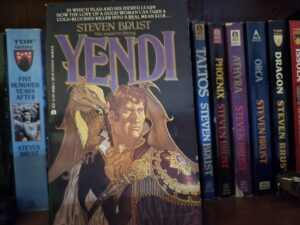
Continuing my semi-serious intention to reread the Vlad Taltos books, we come to volume two, Yendi. If book one did not provide a sufficient clue that these novels will be presented in chronological order, Yendi ought to do the trick. Vlad tells a story of his early period in the organization running his own territory, his first taste of being a minor boss. But someone wants his turf.
So, yes, this is a mob turf war story, also containing a mystery concerning precisely why a boss one step higher up the organization’s rungs wants to stir up bloody trouble. Reading this, I can’t help but consider that it might have been an influence on my own novel, Boss, which also involves an organized crime power struggle in a fantasy setting.
The moves, countermoves, assassination attempts, and investigation all move along with enjoyable ease. Brust shows the meet-cute moment when Vlad first encounters his soon-to-be-bride, Cawti. She murders him. Don’t worry; he gets better. Visits to Castle Black, and the banter and conflict among Morrolan, Aliera, and Sethra are always highpoints for me. Vlad concocts an elaborate, dangerous scheme, reveals the mystery, ends the turf war, and gets the girl. On the reread, Yendi remains a favorite.
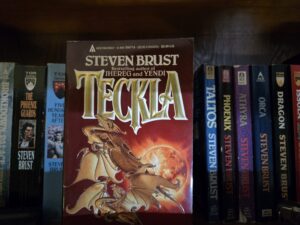
I wish I could say the same for the third book, Teckla. Now, Brust makes no secret concerning his unsavory political bent. But usually he keeps his viewpoints firmly tucked away in his novels as subtext. Usually. And I’m quite good at deliberately ignoring subtext. I don’t intend to allow a political difference to deprive me of a good story. Unfortunately, in Teckla, subtext becomes plot; the “sub” is erased. Brust indulges his fantasies of standing on the barricades in Paris, liberty cap at a jaunty angle. While I will happily stand and salute the American revolution, the various French uprisings — whether against the monarchy or any of the sequential republics — do not stir any particular sympathy in my bosom.
The book is set some time following the events of book one. Cawti, it seems, has joined a revolutionary movement, part of the inner circle of a Svengali, a pivotal Marx or Robespierre figure dedicated to freeing the humans and serf-like Teckla from the shackles of the Empire. Or, whatever. Vlad is forced to confront his own image of himself as a criminal, and as an Easterner (human) in the context of the status quo and his position in it. His marriage begins to crumble.
A pall of gloom smothers the book. The whole thing is dreary. None of the Castle Black crew make much an appearance. The panache of Vlad’s narration is muted. Tonally the book is off. Unlike the previous two, the narrative does not speed you along. It trudges. There are a couple of good action scenes. The few bits with Kragar and others of Vlad’s crew are points of light. And the pace picks up a bit near the end. But overall, this is a low point in the series. I’m hoping book four reminds me of why I’m fond of these stories.
There’s a series I’ve been fond of writing. You just might enjoy reading it. Book two is available now: Twilight Galaxy: Long Gambit.

2 comments