
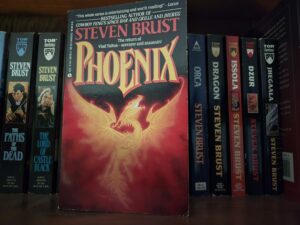
And so the reread of Steven Brust’s Vlad Taltos series continues. Phoenix is the fifth volume. Much as a story follows a rise and fall in action, like a roller coaster, there — unfortunately — appears to be a rise and fall in my appreciation of each succeeding entry. I truly enjoyed Taltos, a favorite, perhaps the apex of the series from my perspective. But with Phoenix we descend, back toward Teckla territory, though I’m glad to say the valley is not nearly as deep.
Vlad, at the behest of his goddess, Verra, undertakes an assassination of the king of an island kingdom, outside the bounds of the Empire. It is a tropical island, blocked by native minerals from the effects of Empire sorcery. (The name is Greenaere. A tropical island named Greenaere. Was Brust still annoyed by Reagan’s invasion of Grenada?) Vlad does the deed. After capture by the authorities, and a rescue by Cawti, Morrolan, Aliera, he returns home to discover that the assassination appears to have precipitated a war.
So far, so good. Some nice action, some humor, some more world building. But here in the second act we again encounter, as with Teckla, Brust’s lamentable politics. His wife, Cawti (they are still married, though increasingly estranged) has been arrested. By who and for what reason are inextricably entwined with the plot and the politics.
Vlad must go to extreme lengths to procure his wife’s release, including meetings with the Empress, and a potentially fatal break with the Jhereg, the organized crime faction.
Now, as an inflection point in the series, having Vlad come to the realization that murdering people for money and working as a crime boss might not be the ideal life, is excellent. Forcing him to abandon that life, with all of the comforts of success, and the familiarity of the city of Adrilankha is a good idea, narratively. He’ll have to rely on his native resources, while being exposed to other portions of the world, allowing for more world building.
The problem is the catalyst, Brust’s pushing of his own ideology. If he could have downplayed it, or come up with pretty much any other inciting event, Phoenix would have been a more enjoyable read. But he did not. Note, for example, the statement of the demon goddess Verra, Vlad’s patron, on page 117 (117, heh. The number 17 is major feature in these books) regarding the political figure behind the uprisings of the poor and downtrodden: “Kelly has his hands on the truth about the way a society works, about where the power is, and the cause of the justice he sees. But it is truth for another time and place.” That’s not downplaying the ideology. That’s highlighting it, pushing a ‘historical inevitability’ line, and placing it in the mouth of a superhuman character in order to amplify its veracity.
That said, the action and intrigue carry the story through, though it is neither as breezy nor as much fun as the previous book. Vlad’s willingness to sacrifice himself, as well as his concern for his friends, his crew, and his grandfather are — almost — touching. Here the smart ass, dismissive style works against itself. And not only does it undercut the emotional aspect, it also muddies the plot. A reader has to pay close attention to figure out exactly what is going on behind the scenes, who is playing what part in all the political machinations.
But we end with what seems a fresh start for Vlad (like a Phoenix, get it?), on the road alone (except, of course, for his two flying jhereg companions.) Perhaps the roller coaster will start inching back up.
Something else inching back up is the sales rate of Twilight Galaxy: Long Gambit. You can help with the process by picking up a copy here. You can also listen to me talking about it here, though watching the video, I’m reminded why I don’t care for public speaking.
