
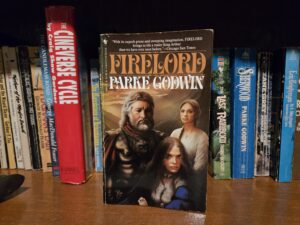
I have intended to reread Parke Godwin’s Firelord for years. But somehow I always picked something else. Perhaps I wasn’t in the mood for yet another retelling of the King Arthur legend. More likely it was just the length. At almost 370 pages it is healthy chunk of paperback. That in itself is no hindrance; the prospect of a longer read can often be an attraction. But sometimes, if I want to reread something, it is in the expectation that something new is on the way, a library book on hold, or a book coming in the mail. So something short is preferable in those circumstances.
This time I did pull Firelord from my shelf, eager to see if it held up. In my recollection, it was an Arthurian story of the realist variety, set in the immediate aftermath of a post-Roman Britain, like Rosemary Sutcliff’s Sword at Sunset, or Bernard Cornwell’s Warlord Chronicles. And that is largely the case. There is a supernatural element of sorts, though whether the Merlin that only Arthur can see is imaginary or not is left to the reader. And whether the split personality Arthur endures while living with the quasi-Pict/Faerie Morgana was induced by magic, a drug, or by his own mind as his ancestry is awakened by kin is also left unclear.
There is, I have to say, a distinct whiff of the 1970s about this book; the imaginative product of a mind marinating in Leonard Nimoy’s In Search Of and theorists propounding notions of foundational primitive matriarchies. In his introduction Godwin does list some references that, I think, tend to support my notion. Additionally, Godwin did seem to believe in an actual, historical Arthur. “Arthur is as historical as Lincoln or Julius Cesar, merely less well documented.” Well, it would be another twenty years until Mike Ashley’s exhaustive examination of the subject The Mammoth Book of King Arthur. Let’s face it, we all wanted there to be some truth behind the legend. We wanted a historical King Arthur, hoping that some archaeologist would uncover the ruins of Camelot, that some diver would bring up the rusted remains of Excalibur.
Parke Godwin at least offers us a plausible vision of what a historical King Arthur might have been like. He works in most of the major elements: the Arthur, Guinevere, Lancelot triangle, the Grail Quest, Badon Hill, Morgana and Mordred. Some things are merely winked at for the reader or ignored, like the sword in the stone, Excalibur, the round table, etc. But Godwin puts together a believable origin and rise to power of Arthur.
Did the book hold up on rereading? Mostly, yes. Like John Steinbeck in his The Acts of King Arthur and His Noble Nights, Godwin is deeply invested in the psychology of his characters. He presents this well enough that it does not function as a drag anchor on the narrative, but there were times I just wanted him to get on with it. The novel is at its strongest during its action set pieces. There is real grit and mud, exhaustion and tension in the battle scenes. Firelord is a worthy entry in the Arthurian genre.
Now to the commercial portion of the post. Plasma Pulp: Lost Worlds remains available for purchase by all discerning readers of star-faring action adventure stories.