
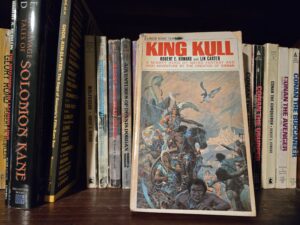
It had been some time since I last read the collection King Kull. Picking it from the shelf was rewarding. The general impression and memory of a Kull story is one of blood soaked battles, with a half-naked Kull butchering a dozen men with an ax. But while there is the occasional red-mist set piece, the stories tend towards the rather musingly philosophical.
Some consider Kull a proto-Conan, merely an eras-earlier incarnation. But the two characters are quite different. While Conan is not the unimaginative lunkhead that some (who clearly haven’t read the stories) characterize him as, he is fundamentally more pragmatic than Kull. With Kull, I get the sense that Robert E. Howard was mulling over issues of reality, of consciousness, seriously considering cogito ergo sum in light of expanding scientific knowledge and the increasingly materialistic modern outlook of the early Twentieth Century. Here are just two surface level examples: In Delcardes’ Cat Kull is faced with issues of causation and time. In The Skull of Science he ponders the concept of epistemology and the idea that reality is inherently illusory.
It is common knowledge that Thulsa Doom in the Conan film is borrowed from Kull. This time through reading King Kull I noticed something that I’m sure many of you already had, but had escaped me. The story The Mirrors of Tuzun Thune begins with these lines: “The comes, even to kings, the time of great weariness. Then the gold of the throne is brass and the silk of the palace becomes drab.” It goes on like this for a couple more sentences. But does it not remind you of Max von Sydow’s King Osric’s speach? “There comes a time, thief, when the jewels cease to sparkle, when the gold loses its luster.”
Then, when Kull is speaking with the eponymous Tuzun Thune, there is this exchange:
“Kull meditated a while then spoke. ‘Can you summon up demons?”
‘Aye. I can summon up a demon more savage than any in ghostland…'”
Does that not remind you of Conan’s chat with Mako, Akiro the Wizard?
It seems to me that Kull was rather influential. And perhaps not only to John Milius. Wheel of Time fans (I’m not one, but I did read the series) might find this line familiar: “The Wheel turns and nations rise and fall; the world changes, and times return to savagery to rise again through the long ages.” Robert Jordan, of course, wrote some Conan novels, so it would come as no surprise to learn he was also familiar with Kull.
Kull muses. Reading Kull makes the reader muse. A neat cycle.
If you are in between books, and don’t have a copy of King Kull handy, why not pick up my latest book, Cesar the Bravo?